Saturday, December 26, 2009

Apple App Store Is Game Sale

The people that know me, know that i am not a big fan of Apple Ipod's, Iphones or even Ipod Touches - and have always been a dedicated N-Gage and Console gaming fan, but ever since the pre-christmas Apple Ipod Touch offers started (such as Now lower Ipod Touch price at £149 with FREE £15 Itunes voucher) i decided to get.

Another reason i got one was because the amount of "decent" gaming titles that were due out on the Ipod Touch (or iphone) platform, one of them being "ROCK BAND" - Which when originally purchased, less than 4 months ago, it costs £5.99.

Now for 1 week (7 days) only there is a HUGE GAMING SALE on the Itunes App Store (or App Store via your Ipod Touch). A Fair amount of NAMCO, Konami and a few other titles have currently been reduced to just 59p (as shown above with PAC-MAN Remix) - this is a great saving espically since some of the titles original cost £2.99 - ROCK BAND is no exception, as that has now been reduced from £5.99 to £2.99 - makes me think i should have waited.

A List of titles (that i have found) that are in the sale include:

* Megaman 2 - £0.59
* Pac-Man C.E. - £0.59
* Pac-Man Remix - £0.59
* Pole Posistion Remix - £0.59
* Mr Driller - £0.59
* Galaga Remix - £0.59
* Dig Dug Remix - £0.59
* Alpine Racer - £0.59
* Garters & Ghouls - £0.59
* Metal Gear Solid Touch - £0.59
* Silent Scope - £0.59
* Silent Hill: The Escape - £0.59
* Dance Dance Revolution - £0.59
* Krazy Kart Racing - £0.59
* SEGA Coloumns Deluxe - £0.59
* Spore: Origins - £0.59
* Wolfenstien RPG - £0.59
* Star Trek - £0.59
* Time Crisis Strike - £1.79
* I Love Katarmari - £1.79
* Scrabble - £1.79
* Rock Band - £2.99

Obviously there could be more on offer, but these (to me) seem more like the interesting titles. So if you got an Ipod Touch (with a FREE Itunes voucher) i believe now is the time to start spending it, as there are PLENTY of deals to be had!


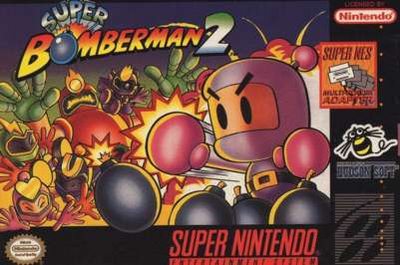
Super Bomberman 2

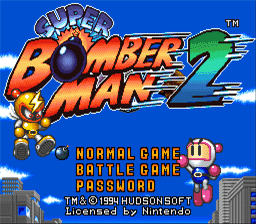
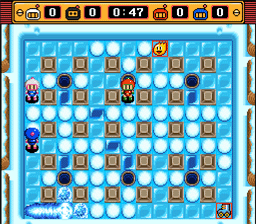
Retro Game of the Day! Super Bomberman 2


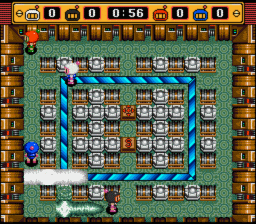
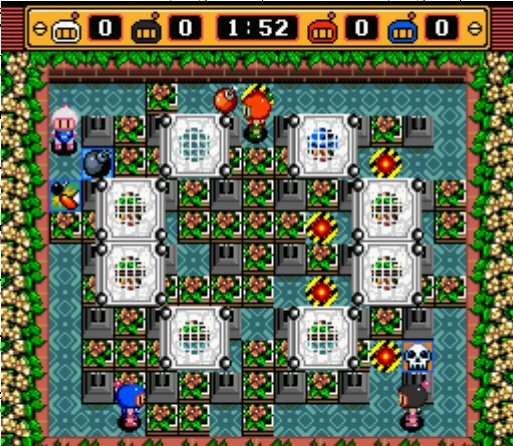
Today's game is the stupendous blast-a-thon Super Bomberman 2 by Hudson for the SNES, released in 1994.


Make sure to download Headcase Games' original release of iFist while it is still FREE for the holidays!

(iTunes Link )

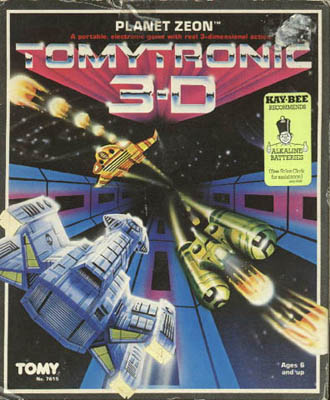
Retro Game of the Day! TomyTronic 3-D Planet Zeon


Retro Game of the Day! TomyTronic 3-D Planet Zeon


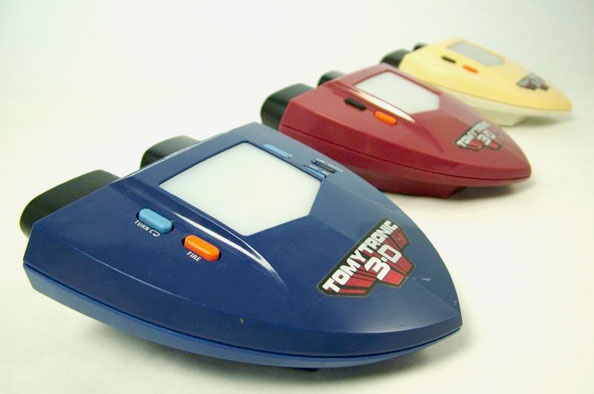
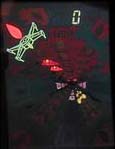
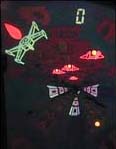
Greetings Programs! And Happy Boxing Day! And from the "File Under: Ghosts of Toys of Christmases Past," I give you - TomyTronic 3-D Planet Zeon! Released in 1983 by Tomy.


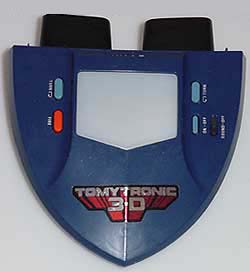
Ah would you look at those things? Back when I was a kid, videogames came in all shapes, sizes and colors. You had your big-mother arcade machines, your sit-down "cocktail machines," your home consoles, your home computers, and ten of course you had your portable systems. Prior to the days of GameBoy, "standalone" units were the norm (that being single-game devices) often utilizing some form of LED or LCD technology, as opposed to any kind of dot-matrix (again, such as the GameBoy). This means rather than proper raster graphics of any sort, you'd be looking at etched pictures illuminated by light-emitting diodes or shapes burned into liquid crystals or what-have-you.


The TomyTronic gimmick was two-fold - 1. The images were the LED style, but they got their light-source externally (so you'd need to stand under a strong source, such as a room's main light, or outside in the sunshine) to see it properly. Easy enough. Number 2 Gimmick was that the games were in THREE-DEE, BAY-BEE.


That's right - outfitted to resemble a pair of binoculars, you'd hold the unit up to your head and each eye would be confined to looking at its own little screen. Each screen was basically showing the exact same image as one another, though with minor appropriate differences in perspective foreshortening so as to give the false perception of witnessing depth. It worked rather well!


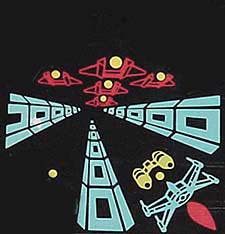
Zeon put you in control of an X-Wing lookalike, flying through a space trench and blasting away at the enemy armada. You'd need to dodge enemy fire and their craft, and be sure to obtain fuel or you'd crash and explode in the silence of space. And no one would ever know your fate. Your memory would be lost to the cosmos... to infinity. Forever.


The game was quite simple, all you could do was dodge and shoot - some rudimentary sound FX supplemented the action. It was a simple little game, as many of its peers were back in the day - and it was primarily intended for little kids to enjoy - but the game was quite fun for a spell, and the 3D effect was certainly unlike anything else available. We had one when I was a kid (I suspect it exists buried at the middle of a landfill somewhere) and I recently re-acquired a new set of the original 3 TomyTronic 3-D games for a few bucks on eBay. Good times!

Got yourself a new iPhone or iPod Touch as a present for the Holiday? Celebrate the Season with a download Headcase Games' original release of iFist while it is still FREE for the Holidays!

(iTunes Link )

Friday, December 25, 2009

Regarding Dragon Quest Clones

Just as Dragon Quest IX mania is sweeping Japan, we reach are own mini version of DQ mania here at Chrontendo.

Perhaps you've seen Final Fantasy or similar 8-bit RPGs put into the context of "Dragon Quest clones." As in, "Final Fantasy was released at a time when countless Dragon Quest clones were hitting the shelves in Japan," or something similar. Yet here we are in Fall 1987 and there is a puzzling lack of games which resemble DQ. Oh sure, we've seen some old school style dungeon crawlers like Deep Dungeon. And tons of hack and slash games with RPG elements or Zelda influences. Magic of Scheherazade and Zoids certainly borrowed from Enix's game, but managed to be rather unique in the way they used the borrowings. So far, the only game that seems 100% DQ inspired is Hercules no Eikou (and maybe Mirai Shinwa Jarvas, but that was a 50/50 mixture of DQ and pure garbage.)

I was getting to the point were I was thinking that maybe all these DQ knock-offs were more hypothetical than anything else. As in, "DQ was a very popular game, thus there must have been lots of similar games released afterwards."

Well, it turns out those DQ clones are real. They were just hanging out behind the shed, waiting for enough other DQ clones to join the gang. Now the forces of DQ clones have organized their ranks and are marching in the streets, kicking in our doors. In Episode 23 we'll see the devastation they have wrought.*


Also, in Episode 23, I plan to do a little Chrontendo update - a few things that I missed or overlooked or was just mistaken about. Most intriguingly, commenter Qun Mang has pointed out that Photon: The Ulimate Game on Planet Earth was in fact connected to the US TV show/Laser Tag center/toy line franchise. I did not realize at first that "The Ultimate Game on Planet Earth" was the tag line for the Photon brand in the US, but now it all makes sense.

For those not familiar with the mind-boggling Photon TV show, well....here you go.


I'd advise you whip out your strongest grade combustibles before attempting to watch these.

Some of you old time NES kids may have recognize Photon as being the source of the "Space Scout Theater" segments of Club Mario from the Super Mario Bros. Super Show.

Also up, a little profile on the great (well, sometimes) developer Irem. So it looks to be a nice episode.

*Don't get the mistaken impression I dislike RPGs. It's just.... well you'll see what I mean when Episode 23 comes out. Ya'll ever heard of a little game called Hoshi no Miru Hito?

Photon image from Virtual Vikki's Photon Page


I Am Become Curly, Destroyer of Worlds!

Chrontendo Episode 22 is here at last, and it's another epic installment. Primarily this is due to the aforementioned bonus content - which turned out to be longer than anticipated. Lately, I've been attempting to give the games featured in Chrontendo at bit more historical context - by showing alternate versions, and so on. Going forward with this idea, I decided to take a look at video games at other platforms.

A quick note - everything seems to be OK at the moment with the video files. As always, the best looking version is the 539 Meg AVI file. There is also a very large MPEG-2 version, but don't bother as it's worse quality than the AVI. The Ogg and MPEG-4 should suffice for those looking for smaller files.

In this episode, we'll begin with a feature looking at computer games of 1987, or at least, what I perceived as the highlights or major releases of that year. Out of necessity, we are sticking to western systems. The release history of the MSX and PC-88 are still pretty murky, at least outside of Japan.

1987 was an interesting time for home computers. When the PC first exploded in the late 1970s, a riot of confusion ensued - with countless models and manufacturers vying for a piece of market share. There was the TRS-80, the TI-99, the Commodore PET and VIC-20, the Apple II, not to mention computers from Atari, IBM and countless others; all of these were incompatible with each other. Overseas, regional brands achieved a certain level of success. By 1987, the market had been thinned out a bit. The older giants, the Apple II and Commodore 64 were not quite dead. Commodore's Amiga and the Atari ST were duking it out for next-gen supremacy. The IBM PC clone, which would achieve total domination in the next few years, pretty much killing every competitor except for Apple, would soon switch to state of the art VGA display standard. For a brief time, however, developers needed to contend with multiple platforms with dramatically different capabilities.


Here for example, we see Wizardry IV for the Apple II and Dungeon Master for the Amiga, both released in 1987. It's almost as if the 2600 and Genesis were competing systems.

Aside from those two games, we'll also see Pirates!, Maniac Mansion, Shadowgate, Leisure Suit Larry, Police Quest, Skate or Die!, California Games, and a number of lesser known games. Most intriguingly, we'll check out Virus and Driller, two very early attempts at full polygon-based 3D.

The next logical step will be a look at 1987's arcade games. This will work its way into a future episode soon. As for now - let's consider some actual Famicom games.

Episodes 22's Grand Champion:

Arabian Dream Scheherazade/Magic of Scheherazade


Wow. I'd played a little of this game before; it seemed like a typical Zelda clone. But upon further inspection it became revealed that Scheherazade was one of the most innovative and unusual games for the Famicom thus far. Not content to rip off Zelda or Dragon Quest, Scheherazade manages to rip off both of them simultaneously. While also ripping off Link to the Past and Chrono Trigger, years before those games came out. Your party grows to 12 playable characters, including a robot (in ancient Arabia! Is this "sandpunk?"), an animated doll with a pumpkin head, two genies, a bottle with arms and legs, and a cowardly shrimp. I wonder if Scheherazade took some inspiration from the Wizard of Oz books? While the game certainly has moments that cause the veins in your head to pop out, I'm willing to overlook that in favor of the high degree of creativity on display. All this from frickin' Culture Brain?! Maybe those guys have promise.

Also Good:

Salamander
/Life Force


Remember back when the Famicom had tons of shoot-em-ups? Like around Chrontendo episode 7-10 or so? Since then, we've had a serious decline in the number of games in which flying ships shoot other flying ships. However, Konami remedies that with this port of their Gradius sequel. Why is the game called "Salamander" when there is a giant snake of some sort depicted on the cover art? It's sort of confusing, but I do discuss this during the episode itself.

Famicom Mukashi Banashi: Shin Onigashima

Last episode, I mentioned a Nintendo game you've never heard of.. Well, now you've heard of it. Nintendo steps outside its platformer-and-sports comfort zone and makes an adventure game. That is, a Portopia style adventure game. Always doing its own thing, Nintendo gives Shin Onigashima a setting straight out of Japanese folklore, particularly Momotarou and Taketori Monogatari. This is definitely the most Japanese game we've seen for the Famicom; even the text runs vertically and from right to left. In a rather unheard of move, Nintendo released the games two discs separately - one at the beginning of September, the other at the end. While unknown outside of Japan, it was popular enough to receive re-releases on the Super Famicom, GBA and Virtual Console

Digitial Devil Story: Megami Tensei


First game in Atlus' long running RPG series. I mentioned this last post, remember?

Bio Senshi Dan: Increaser Tono Tatakai


The other Atlus developed game this episode. Never released in the US, but.... Jaleco completed an English translation and then scrapped it. Luckily, unlike Higemaru Makaishima, I remembered the English version and used it for this episode. I suppose this would be an ideal time to give a shout to Lost Levels. Unlike myself, LL's Frank Cifaldi seems to be genuinely knowledgeable about video games, and his site is undoubtedly where I first heard of the unreleased localizations of Higemaru and Bio Senshi Dan. For some reason, the main site has not been updated in a while; all the action is currently in the forums.

Kyonshiizu 2


Ok, not technically a good game. However, I gave a tease about this recently by posting a video clip from Hello Dracula. So what's the story with that clip? Well, Kyonshiizu 2 is based off the sequel to Hello Dracula, a Taiwanese (not from Hong Kong, as the fellow who made the video clip seems to believe) film, originally titled 幽幻道士2. There were actually several sequels made; I'm not sure of the details, but the films somehow found themselves broadcast as a mini-series on Japanese TV, under the Kyonshiizu name. Kyonshi is simply the Japanese name for Jiang-shi, what you and I would call a "hopping vampire." These things turn up in video games from time to time. We've already seen them in Kung Fu Kid from Chronsega 3. Even Mario has encountered them - in Super Mario Land to be exact.

So anyway, this is a perfect example of what I like about this gig. Upon booting up Kyonshiizu 2, it seems like just just another baffling Japanese graphic adventure game. Now we know the back story behind the game, which is probably more interesting than the game itself! I was quite amazed when I realized the connection to a semi-obscure cult kung-fu movie like Hello Dracula.

Naturally, Episode 22 has a few dogs as well.

Photon: The Ultimate Game on Planet Earth

This preposterously titled dud from Takara came out the same day as Transformers: The Head Masters - August 28th, the same day as Castlevania 2 and Kiki Kaikai. I guess that proves there is some sort of karmic balance in force in the world of video games.

SWAT

Ugly as hell first person RPG-like game from Toei and Bear's, the good folks who brought you Hokuto no Ken. SWAT actually has an interesting premise: you control a four member SWAT team assigned to take out terrorists holed up in an office building. You encounter the terrorists in in Dragon Quest-y turn based battles. It turns out Bear's/Shoei System can't do RPGs any better than they can action games.

Zoids


OK, maybe this game isn't really that bad. But the opening sequence, ripped off directly from Dragon Quest, with your Tyrannosaurus Rex shaped mech standing in a throne room, taking instructions from a king, then marching down the stairs and chatting it up with NPC dinosaur mechs who are hanging around the palace, nearly had me falling off my chair laughing. Once you head out onto the overworld, you'll see Zoids is a combination of DQ and Battlezone! From Micronics, naturally.


Other games this episode:

Tsuppari Oozumou

One of the very first sumo video games. This Tecmo titles plays like a wrestling game with less mobility and fewer moves. It does have plenty of almost nude fat guys however, so if that's your thing....

Star Gate/Defender II

HAL ports Williams' 1981 arcade game. It's been a while since we've seen a port of a game this old.

Spy Hunter

For some reason, there is a brief run of ports of ancient arcade games in fall 1987. Expect some more over the next few episodes. This one's a US only release from Sunsoft.

Spelunker II: Yuushahe no Chousen


This original title is nothing whatsoever like the original Spelunker. Its more like Super Pitfall, though better. Irem, like SNK, is having a pretty unimpressive run on the Famicom so far.

Ide Yosuke Meijin no Jissen Mahjong

Episode 22's requisite mahjong game? Check. From Ide Yosuke, the John Madden of mahjong games.

Family Trainer - Manhattan Police/Street Cop

A police brutality simulation game for the Family Trainer. Unlike most other FT games, this was released in the US by Bandai themselves.

So, feel free to go to archive.org to stream or download Episode 22.

Thursday, December 24, 2009

Why Must Everybody Laugh At My Mighty Sword?

Chrontendo Episode 23 is here, available to stream or download from archive.org, as usual. For those paying attention, you'll know Episode 23 is the spectacular all-RPG (not quite, but it feels that way) episode.

Pity the poor 8-bit RPG hero! Nameless, speechless, these little fellows step forward with only their leather armor and daggers to battle slimes, rats, wolves and - in Hoshi no Miru Hito - robots. Let's face it, in their pixelated versions, these guys got the short end of the stick. How could any of them live up to the standards of bad-ass warriorhood as portrayed on their games' cover art? For the example, take the protagonist of Kemco's Indora no Hikari.


Wow. This guy cuts a rather imposing figure. Would you want to mess with such an fearsome dude? Certainly, he could make short work of dragons and wyverns. However, in the game itself...


...oh my. Kid, I think your mother's calling you. Seriously, put that sword down - you might hurt yourself. Also notice the lack of cool explosions.

Alas, our hero's predicament is all too common. Very radical fantasy themed box art may conceal a very graphically non-inspired game. And the gameplay also frequently suffered from a lack of inspiration. Most of these RPGs are simply a mix-and-match of a few basic gameplay choices. Single-member party or multiple party members? Turn based combat or real time, "bump the enemy" combat? Enemies visible on the overworld or random enemy encounters? DQ style overworld or Zelda style flip-screen overworld? Let's do a quick rundown of this episode's seven RPGs.

Ultima: Exodus


The odd man out this episode, Pony Canyon's Exodus is a port of Origin's enormously influential 1983 computer game. Dragon Quest took the basic stucture from Ultima III: Exodus and tweaked it to be more appealing to Japanese gamers. Since DQ spawned pretty much the entire JRPG scene, I suppose every subsequent JRPG owes Exodus some sort of debt. Of course, trying to play the game is another story. Much of the game is boring, repetitive and maddening, especially the truly bizarre system for leveling up. Unfortunately, Exodus is one of those all time classics that's difficult to play today.

Momotarou Densetsu


Hudson's game is the most blatant example of a Dragon Quest knock-off this episode. It's also the RPG with the best production values and the smoothest gameplay. Attractive graphics and thoughtful music combined with an improved interface manage to sand off some of the rough edges of DQ. Additionally, the game's unusual setting (Momotarou Densetsu is based on the same material as Nintendo's Shin Onigashima) sets it apart from the other RPGs this episode.

Sword of Kalin

Also known as Kalin no Ken or Kalin no Tsurugi, this is an action RPG version of Dragon Quest 1. Rather infuriating combat takes this one down a few notches. However, it has been unofficially translated into English, making it a bit more accessible for western gamers.

Minelvaton Saga


This Taito published (but Random House developed) title manages to be better than Mirai Shinwa Jarvas. It is very similar to Sword of Kalin, right down to the Hydlide style of combat. There's really nothing remarkable or notable about this game at all.

Indora no Hikari

The best thing that can be said about this Kemco published game is that it's better than you would expect from a Kemco game. Turn based combat takes place on a Zelda influenced overworld. And as shown above, the hero looks like a complete weenie. Still, it's better looking and sounding than Kalin or Minelvaton.

Hoshi no Miru Hito

Discussed in depth a couple posts back. Terrible, buggy, turn-based RPG that does almost everything wrong. But don't take just my word on it. Hardcore Gaming 101 has an extensive write up on the game.

Haja no Fuuin

The least DQ like of all this episode's RPG, Haja is a port of a Japanese computer game from 1986. It's actually nothing at all like the other games discussed here. The most unique feature about this game is thatit's only game we've seen so far to receive a simultaneous release on the Famicom and Sega Master System! The superior SMS version actually came out a week before the Famicom's, so for one brief, shining moment, SMS owners had something to crow about. I give Haja the short shrift this episode, since it will be covered in more detail in Chronsega Episode 4.

But this episode isn't all RPGs. Unfortunately, nothing really stands out among the rest of the games. Probably the most interesting is Konami's Falsion.


Falsion is a shoot-em-up in the Space Harrier/After Burner mode. It was one of the few games to make use of Nintendo's high-tech Japanese 3-D goggles. While there's nothing too terribly wrong with the game, I'd award it a pretty low position in the Konami Famicom pantheon.

Kaiketsu Yanchamaru/Kid Niki: Radical Ninja

Irem ports their 1986 arcade game. I'd consider 1985-1986 to be the "dark ages" for Irem - a fallow period between the successful Kung Fu Master and the game-changing R-Type. Kid Niki is a standard side-scrolling action platfomer, its US release being the only special thing about it.

Youkai Yashiki


Irem's other game this episode is a port of a 1986 MSX game from Casio. Once again we have a game based around youkai (last episode's Kiki Kaikai was another one.) It resembles a much simpler version of Maze of Galious - lots of running around and climbing ladders looking for key items... scrolls, in this case.

Esper Bouken Tai

A rather bizarre Metroid like game from Jaleco featuring a character with amazing jumping abilities and animated household appliances. For some reason, Japanese game designers have a fascination with ESP. See also Esper Dream, Spelunker II and Hoshi no Miru Hito for other examples of ESP themed games.

And our bottom-of-the-barrel scrapings:

Millipede - Another old arcade port from HAL. There's nothing wrong with the arcade version of Millipede, but I question the need for a less than perfect port of an old game that had already been released multiple times.

Karaoke Studio Senyou Cassette Top 20 Vol. 1 - As far as I can tell, this is simply a rerelease of Bandai's Karaoke Studio with a few new songs added in. Perhaps I'm missing something.

Pulsar no Hikari: Space Wars Simulation - An utterly baffling space simulation game. Soft Pro International are the same folks who made the equally baffling Breeder.

Topple Zip - It's sort of like Twin Bee, only it's not good.

Butwaittheresmore! Also in Episode 23, we have a look at the history of the great developer and manufacturer Irem! Those of you following Chrontendo will probably be less than impressed by Irem's output so far. Such gems as Super Lode Runner and Spelunker are not going to turn many heads. But Irem's real strength lies in their fantastic arcade games, particularly those of the late 80s and early 90s.


Irem looked at Konami's Gradius and said, "We will make a game like this. Only more awesome!" For God's sake, the entire third level of R-Type is simply your R9 slowly taking down an enormous mothership jammed packed with laser cannons, thrusters, and all sorts of surprises. Over the next few years, Irem continued to up the ante with games featuring detailed graphics, enormous bosses, huge explosions and over the top action.


Also this episode - more Hokuto no Ken! We briefly return to Chrontendo's favorite whipping boy for a special Chrontendo update, where I try to correct a few of the more glaring omissions from earlier episodes.

So head on over to archive.org and enjoy.

Would Some Bonus Content Help?

So once again, Chrontendo is behind schedule. It's not due to pure laziness, really. I've been getting my house painted for the last week, and we decided to get the garage painted at the last minute. If you've ever needed to clear out a garage that's been collecting stuff for a few years, you'll know its a huge and time consuming effort.

Of course, Episode 24 would be done by know if it weren't for.... Bonus Content! Yep, the promised followup to the computer game round-up is here. We'll be checking out the arcade games of 1987.


One of these games is called "Double Dragon." For some reason, it's not the one on the left.

And I just now realized that the last post was rather heavily centered on screenshots featuring half naked men. I hope everyone enjoyed this special "all-Beefcake" post. It all ties into my plans to eventually transition Chrontendo from video games to a Tom of Finland fan site.

Episode 23 Not Late?

Yes, it appears that Chrontendo Episode 23 might just come out in a somewhat timely fashion. Fancy that. Keep your eyes peeled for a release in the next few days.

As mentioned last post, this episode is jam-packed with RPGs, most of which aren't particularly memorable, but one title really stands out. Not because it's a good game. No, just the opposite; it has a reputation as being one of the worst RPGs ever.

You might recall Black Bass, the fishing game from the idiotically named Hot-B. We covered it back in Chrontendo Episode 15 (coincidentally, an RPG heavy episode also featuring DQ II). Well, for reasons known only to themselves, Hot-B decided made an attempt at a wildly ambitious turn-based, futuristic RPG, Hoshi no Miru Hito. The strange thing about Hoshi no Miru Hito is that while it's certainly this episode's worst game from a gameplay and technical standpoint, I found myself drawn to it more than the better games. There is a certain trainwreck sort of appeal to the game.


What exactly is wrong with Hoshi? Virtually everything you can possible imagine. From a graphical standpoint, the game is aggressively ugly. The tile based backgrounds are a riot of garish color schemes and bizarre geometrical patterns. The game is supposed to have a sci-fi setting, but there's very little to visually suggest that. When entering new area, its impossible to know exactly where you are supposed to be, since backgrounds don't really look like anything in particular. Inside or outside? In some sort futuristic laboratory or in some dilpadated industrial area? In a cavern or a in a man-made structure? You really can't tell.

Balance is another major issue. You can immediately encounter enemies with magic attacks powerful enough to kill you in a couple hits. Surviving long enough to level up a couple times is a matter of luck more than anything else. However, once you have leveled up a bit and purchased a decent weapon you'll find the enemies have become very easy to defeat. This would not normally be a problem, except that these same 5 or six enemies are the only ones you will encounter on the main overworld. This makes leveling absurdly slow and boring and doesn't prepare you for the tougher enemies found in the second area of the game. At that point, you find yourself facing enemies so strong you literally cannot inflict a single point of damage upon them. Its as if Final Fantasy took you straight from fighting Imps to Red Giants.


Beyond this, there are countless silly little problems with Hoshi no Miru Hito. Some appear to be stupid technical bugs - such as the last digit of your hit points not being displayed while in battles. I.E., if you have 100 HP, it will show as 10 HP! The game also has a weird habit of warping you back to the starting point when you exit a town or dungeon. You have a four member party, but each character's inventory is completely separate and you cannot transfer weapons, armor or gold between characters. Some floors will do damage as you walk over them, but the game gives you no indication of this, undoubtedly resulting in surprise game overs for many players. And the battle menu requires that you select the order than you want your characters to attack in for every single battle, something that gets tiring very quickly. And in the original, unhacked Japanese version, your character moves jaw-droppingly slowly across the world map.


While quite a few 8-bit RPGs suffer from frustrating and outdated gameplay mechanics, I've never encountered anything quite like Hoshi no Miru Hito. Presumably some of the quirks were deliberate, in an attempt to make the game more "challenging" or, at least, longer. Others can only be weird oversights or general incompetence on the part of the designers. Hoshi's unique place in the world of RPGs has earned it a bit of cult following, with an English translation with character movement sped up (used in Episode 23), a hack that improves the background graphics, and a fan created, completely reworked version for Windows. Quite impressive for a game this terrible.

Wednesday, December 23, 2009

So Hey There!

I've finally finished the last game this episode, Konami's wacky and impossible Zelda clone, Dragon Scroll. I'm not sure why, but I felt the need to see this game through to the end. Probably because I knew the final battle would be dragon-on-dragon action, something you didn't see in too many video games back then.


So now's there's a chance I'll be able to slap together episode 25 over the next few days. Incidentally, Dragon Scroll is one of four Konami games this time. Sadly, it's the only one of much interest.

I'm Truly Sorry

What's that you say? Sorry for the delay in posting an update? No, that's not it. Though now that you mention it... an update is a little overdue.

Chrontendo Episode 24 is progressing, but slower that I anticipated. Various preoccupations have been eating away at my time. I'm probably the last person on Earth to read it, but after a couple years of procrastinating, I've picked a copy of Doris Kearns Goodwin's epic Lincoln book Team of Rivals. It's turned out to be a real page turner, and surprisingly hard to put down for a book concerned primarily with political maneuvering. Also, spurred on by the price drop, I decided to finally get Rock Band 2! Now I can work on my chops and stop making a fool of myself whenever I sit behind the drums. The first time you sit behind the drum kits, it's as if someone handed you a ticking bomb and asked you to defuse it. You really have no idea what exactly you are supposed to be doing.

Oh yes! I said I was sorry about something. The reason being that with Chrontendo Episode 24 were are turning to a new chapter in the history of the NES. A dark, dirty chapter; one whose pages are stained with the tears of NES owners. So far we've only seen games of Japanese origin. Even the handful of US only releases we've covered have been from Nintendo, Data East and so on. However, October 1987 witnesses the emergence of US-based publishers releasing games exclusively for the US market. LJN Toys released their first three games that month, Karate Kid, Jaws and Gotcha! The Sport.


People often associate LJN with Acclaim, but at this point they were still owned by Universal. Their first three games are all tied into Universal films. Karate Kid is a substandard platformer until the third level, at which point it becomes an exercise in pure frustration. The third level, the monsoon level, must go down as one of the most hateful gaming experiences I've encountered in Chrontendo so far. To top it all off, the game is not even based on Karate Kid, but on the lame sequel, Karate Kid II!


A similar bait and switch occurs with Jaws. If you picked up this game hoping to play as Roy Schneider or Richard Dreyfuss, forget it. The game is actually a tie-in to the 1987 franchise-killer Jaws: The Revenge. The most striking thing about Jaws is its extreme shortness. Once you've gotten the hang of the game, you can complete it in a matter of minutes. A speed run of the game clocks in at 3:58! The game itself simply consists of cruising around the tiny overworld map in your boat mixed with underwater action sequences that could have been lifted out of an old 2600 game.

Gotcha! a light gun game, manages to be quite playable, so it's the odd man out here. Jaws and Karate Kid, to a certain degree, strike me as having a distinctly mid 80s Western style of game design. Both games take several half-baked ideas and simply string them together to form a longer game. Karate Kid combines a level of one-on-one fighting, a few platforming level and some microgames. Jaws is even more inchoate. Several types of basic action sequences are simply slapped together; none are strong enough to hold the gamer's interest. The result is similar to titles such as Ghostbusters and Winter Games. The surprising thing is that both Jaws and Karate Kid were outsourced to Japanese hands: Westone worked on Jaws and Atlus on Karate Kid (the microgames in Kid seem to have a relative in Bio Senshi Dan's wrestling sequences). The always fascinating Game Developer Research Institute has had some interesting posts on LJN lately, including the Atlus connection. Presumably LJN's titles were produced quickly and cheaply, which would explain the huge step down in quality from games like Wonderboy and Megami Tensei.


After these three titles, LJN would go on to release a number of carts for the NES, mostly based on existing IPs, and mostly terrible. And it won't stop with LJN. Acclaim will release it's first NES game designed for the US market later in 1987. Other companies will follow: High Tech Expressions, Gametek, Milton Bradley, Tradewest, et al will emerge over the next couple years. By the late 80's, American gamers will get to experience what Japanese gamers have known since 1985: tons of quickie licensed games crowding the shelves. Come to think of it, that's still the case to this day.

But, don't worry -- it's not all bad news this time around. We'll also get some good games, namely Faxanadu, Bubble Bobble and a little something called Punch-Out!

The End of An Era

More accurately, Chrontendo Episode 24 will mark the end of two eras. First off, we'll be covering the beloved boxing game Mike Tyson's Punch-Out!! (or just Punch-Out!!, as it has also been titled at times). "Ah, Punch-Out!!" you say. "Great game. I spent eons trying to knock out Mike Tyson, back in the day. What of it?"


Well... recall that Nintendo entered the video game field in the mid 1970s. Their early output was typical of the time: Space Invaders clones and whatnot. Then in 1981 they suddenly struck massive pay dirt with the release of Donkey Kong. DK and its sequels put Nintendo into the upper ranks of arcade game manufacturers. Additional successes, such as Popeye in 1982 and Mario Bros in 1983 cemented their position. However, after only two years since the first flush of success, Nintendo decided to focus their energies on the home market instead. At the time, this would have been a very unusual, almost suicidal, move. Atari and Sega both released home consoles, but managed to divide their attention between producing arcade hits and releasing a study flow of cartridges simultaneously. Nintendo decided to focus entirely on the home market, releasing a mere trickle of original arcade titles.

Punch-Out!! hit the arcades in 1984; a sequel followed shortly afterward. From a technical perspective , Punch-Out!! was far and away the most impressive game Nintendo had released. Enormous, lifelike characters, and realistic human speech allowed the game to stand apart from its contemporary brethren. The game was quite successful, but the series was Nintendo's last stand at the arcades. Punch-Out!!'s unusual follow-up, Arm Wrestling, would be the final original arcade game Nintendo released before devoting itself entirely to the Famicom and NES. Nintendo's presence in arcades would be limited to machines such as the Playchoice 10, which was simply a system for playing virtually unmodified NES games on an arcade cabinet.

Nintendo created popular and innovative arcade titles; it's too bad they chose to abandon the field entirely. The Famicom debuted with an arcade port, Donkey Kong, in 1983. Punch-Out!!, in 1987, would be the final Famicom port of a Nintendo arcade game, thus ending that particular chapter.


Mike Tyson's Punch-Out!! was released in October 1987. Strangely enough, that same month saw another milestone; one that was, in retrospect, the first nail in the coffin of the 8-bit generation. Hudson Soft had been working on a new chip set -- one superior to that found in the Famicom. Hudson then partnered with electronics giant NEC to produce a video game console based around this chip set. The result, dubbed the PC Engine, was released in Japan on October 30.


There is some debate over whether the PC Engine can be considered a true 16-bit system. It used a 16-bit graphics processor and an 8-bit CPU. Regardless of the technical specifications, there could be no doubt the PC Engine was a next-gen console. Anyone who booted up the machine and plugged in an early title like Kung Fu, could instantly see the system's capabilities far surpassed that of the Famicom or Master System. The Famicom/NES remained a viable console until the early 90s, but anyone could see the writing on the wall. Sega shrugged off the failure of the Master System and went to work on their own 16-bit system, to be released almost exactly one year later. Nintendo themselves belatedly followed suit in late 1990. Famicom, your days are numbered.

Don't be all sad though. The good times for the Famicom are really just getting started. The 1987 holiday season will see three major franchises rolled out, as well as several interesting one-offs and a handful of sequels. Episode 24 takes us into November, so once that episode drops (very soon!), the end of the year madness will begin.
 
Copyright @ 2008-2010 Game Center | Free Game | Powered by Blogger Theme by Bayuhin